
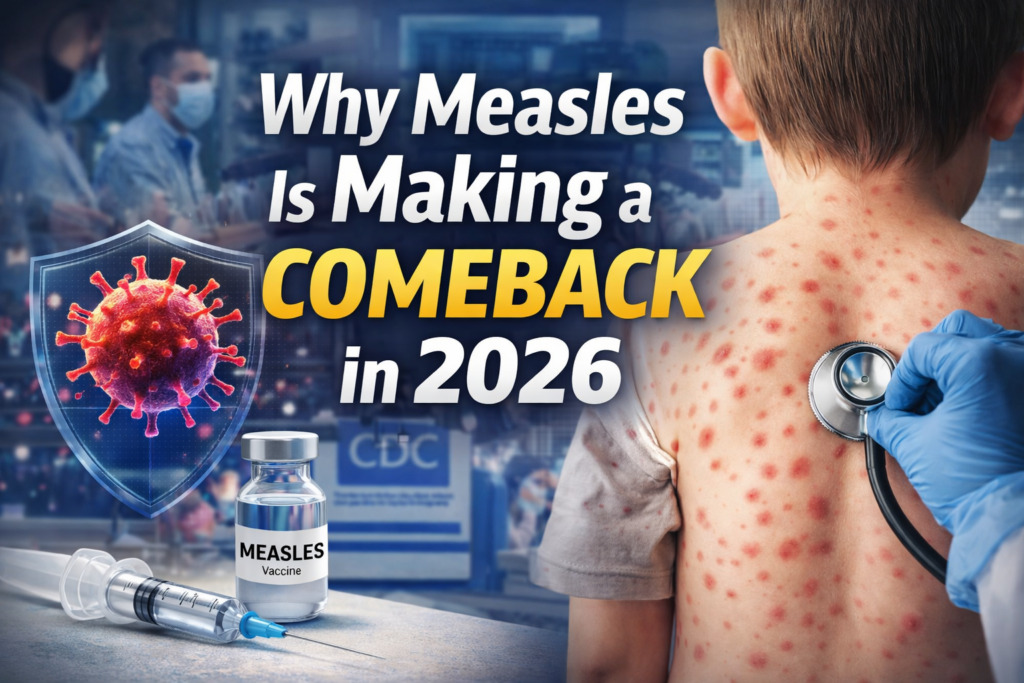
The Reason Measles is Coming Back in 2026.
By 2026, measles is becoming a huge public health narrative once again as health officials are reporting new outbreaks in several areas and that declining vaccination rates are providing new avenues of proliferation of the virus. In the United States, as of March 19, 2026, the CDC reported 1,487 reported cases of measles as confirmed. The agency reports that measles outbreaks are taking place in the world also, which means that the imported cases, as well as the cases of local transmission, represent an ongoing threat.
The resurgence is threatening since measles happens to be one of the most transmittable illnesses. The virus is transmitted by air and can travel fast with the help of schools, households, and densely populated places when a sufficient number of individuals are unprotected. The World Health Organization indicates that any person that is not immune may get infected, and the greatest risk concerns the unvaccinated young children and pregnant individuals who could develop severe complications.
According to the experts in public health, the primary cause of the increased cases of measles is the following: in too many locations, vaccination rates are not high. According to WHO, the prevention of measles relies on the coverage of two vaccine doses and very high coverage of communities. Small droplets may cause immunity breaches that are sufficient to trigger outbreaks, particularly during travel-related transmission of the virus.
Such loopholes enlarged during the post-pandemic years, when the program of regular immunization was interrupted in most countries. WHO reports that recovery has been made in certain areas, and millions of children have missed scheduled immunizations. That is important since measles does not require having a big opening to propagate. When groups of unvaccinated individuals form, a small outbreak spreads into a significantly bigger one when a single infected person is brought into the country.
The current statistics indicate the extent to which the issue has expanded. In the WHO Region of the Americas, two thousand three hundred one hundred eighty-two cases along with three death cases of measles were confirmed in the first quarter of 2025 in six countries, a 11fold increase compared to the same period in the previous year. WHO indicated that the majority of those cases were in individuals who were not vaccinated or their status was unidentified and that a great number of them were imported or had connections to importation.
Weakened protection has also been experienced in Europe and Central Asia. According to WHO and UNICEF, 127,350 measles cases were reported in the European Region in 2024, twice as many as were reported in 2023 and the highest number to be reported since 1997. Even though the cases decreased in 2025, in February 2026, WHO warned that the possibility of outbreaks will not disappear since not all communities have high rates of routine vaccine coverage.
Undervaccinated communities also become one of the key issues that officials in the United States are pointing to. In an assessment of a CDC scenario on the 2025-2026 outburst in South Carolina state, authorities had recognized 990 instances in the Upstate area by March 3, 2026. The CDC reported that the outbreak was focused on a region with low rates of MMR immunizations and high population density with low rates of vaccine immunizations.
Health agencies explain that the issue does not just lie in the matter of access. In other parts, the families have transport issues, lack of clinics, war or poor health infrastructure. Misinformation and vaccine hesitancy are having an increasing role in others. Authorities maintain that the measles vaccine is safe, effective, and cheap and has been in use over decades. WHO suggests two doses as the national immunization program.
The experts explain that there should be one point, which the population should know; measles is not an innocent child disease. According to WHO, it may cause severe complications, such as pneumonia, swelling of the brain, hospitalization, and death. Guidance issued by CDC also cautions that global outbreaks can easily reach the United States since someone may carry the virus home to countries with a significant outbreak such as the ones that Americans visit quite often.
The word of the authorities in the field of public health in 2026 is straightforward. Check on the record of vaccination, catch-up the lost doses and never reckon that measles is over. The recent measles outbreaks are a reminder that constant disease control in a community requires that protection should be upheld annually. Measles comes back quickly when the percentage of vaccinated people reduces. And when it comes back, it is much harder to contain than prevent, according to the health agencies.
Comments (0)
Sign in to leave a comment