
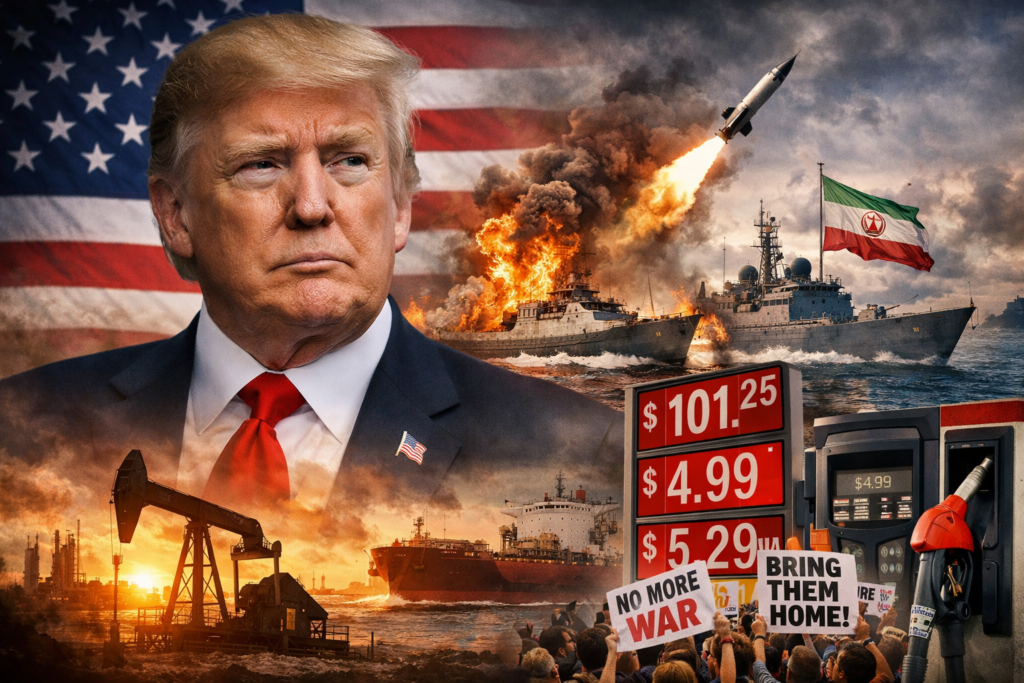
The ongoing confrontation between the United States and Iran is rapidly becoming one of the defining geopolitical challenges of President Donald Trump’s administration. While military officials claim that U.S. operations have successfully degraded key elements of Iran’s naval and missile infrastructure, pressure is quietly building within the White House to define a clear endpoint to the conflict. Advisors are reportedly encouraging the president to declare a “mission accomplished” moment and pivot back toward economic pressure rather than prolonged military engagement.
Behind the scenes, the debate is increasingly shaped by economic realities, domestic political concerns, and the strategic risks of deeper escalation with Iran.
The Push for an Exit Strategy
Several senior advisers believe the administration has already achieved its primary tactical objectives: weakening Iran’s ability to threaten shipping lanes and reducing its missile strike capacity in the region. From this perspective, extending the military operation carries diminishing returns and growing political risk.
The concept being floated inside the administration is an “exit ramp” — a carefully crafted narrative that frames the current stage of the operation as a strategic success. Officials pushing this idea argue that announcing a successful mission would allow the administration to:
- Avoid deeper military entanglement in the Middle East
- Prevent further disruptions to global energy markets
- Shift focus back to diplomatic and economic pressure tools
Such a declaration would echo previous moments in U.S. foreign policy where military actions were framed as limited objectives rather than open-ended conflicts.
However, publicly, the White House has rejected any suggestion of internal disagreement. President Trump has maintained that the operation is proceeding “ahead of schedule” and insists that the United States remains fully in control of the situation.
Oil Prices Become a Major Pressure Point
One of the biggest drivers behind the internal push for de-escalation is the surge in global oil prices.
Following the escalation in tensions with Iran, crude prices have climbed above $100 per barrel, sending shockwaves through global energy markets. The Middle East remains one of the world’s most important oil-producing regions, and even limited disruptions to shipping routes or infrastructure can quickly push prices upward.
Higher oil prices have direct consequences for American consumers. Rising fuel costs translate into more expensive transportation, higher shipping costs, and ultimately increased prices across the broader economy.
Economic advisors are warning that prolonged instability in the region could fuel inflation and slow economic growth at a particularly sensitive moment for the administration.
For a president who has frequently highlighted economic performance as a core achievement, sustained energy price spikes represent a significant political vulnerability.
Public Opinion and War Fatigue
Another growing concern inside the administration is public opinion.
Recent polling suggests that while Americans initially supported targeted strikes against Iranian military capabilities, enthusiasm for an extended conflict is far weaker. After two decades of military engagement in the Middle East — including the wars in Iraq and Afghanistan — many voters remain deeply skeptical of open-ended operations in the region.
Strategists close to the White House fear that if the conflict drags on without a clear objective, it could quickly erode public support.
Political advisors are therefore urging the president to frame the current moment as a strategic victory rather than the beginning of a prolonged campaign.
This approach would allow the administration to argue that decisive action achieved its goals while avoiding the perception of a long-term war.
The Return to “Maximum Pressure”
If the administration does pivot away from direct military engagement, the likely alternative is a return to the economic strategy known as “maximum pressure.”
During earlier periods of tension with Iran, the United States imposed sweeping sanctions targeting Iran’s financial system, energy exports, and international trade networks. These measures were designed to weaken Iran’s economy and force concessions in negotiations over its regional activities and nuclear program.
Supporters of the strategy argue that sanctions provide a powerful tool without the risks associated with military escalation.
By tightening financial restrictions and coordinating with allies, the administration could continue applying pressure on Tehran while reducing the immediate risks of armed conflict.
Critics, however, argue that sanctions alone rarely produce rapid political change and may instead prolong tensions without resolving underlying disputes.
Election-Year Calculations
The timing of the crisis also intersects with a crucial political calendar. The United States is approaching the 2026 midterm elections, and the outcome will shape the balance of power in Congress.
Historically, foreign policy crises can either strengthen or weaken an administration depending on how they unfold.
A short, decisive operation framed as a success could reinforce the image of strong leadership. On the other hand, a drawn-out conflict that triggers economic disruption could become a political liability.
Rising gasoline prices, in particular, tend to resonate strongly with voters because they affect daily life so directly.
Campaign strategists are therefore watching the situation closely, aware that developments in the Middle East could influence domestic political dynamics in the months ahead.
Managing Escalation Risks
Beyond domestic politics, the administration must also consider the broader strategic implications of continued confrontation with Iran.
The Persian Gulf region remains a complex web of alliances, rivalries, and proxy conflicts. A direct military clash carries the risk of drawing in other regional actors or disrupting global shipping lanes that are critical to international trade.
Military planners have reportedly emphasized that while the United States possesses overwhelming capabilities, avoiding unintended escalation remains a key priority.
Even limited engagements can spiral if retaliatory actions trigger broader responses.
This reality reinforces the argument among some advisors that defining a clear endpoint to current operations may ultimately serve U.S. strategic interests.
The Administration’s Public Message
Despite reports of internal discussions about an exit strategy, the White House continues to project confidence and unity.
President Trump has repeatedly stated that the operation is proceeding successfully and has dismissed speculation about internal divisions.
Officials argue that the United States will determine the timeline of its actions based solely on national security considerations rather than political pressure.
From the administration’s perspective, signaling hesitation could encourage adversaries to test American resolve.
The Road Ahead
The coming weeks may prove decisive in determining the trajectory of the conflict.
If military objectives are deemed largely achieved, the administration could begin shifting toward diplomatic messaging and economic measures. A “mission accomplished” narrative would allow the White House to present the operation as a successful demonstration of American strength while reducing the risk of prolonged war.
However, the situation remains fluid. Iran’s response, regional dynamics, and global market reactions will all play critical roles in shaping what happens next.
For now, President Trump faces a delicate balancing act: projecting strength abroad while managing economic and political pressures at home.
Whether the administration chooses escalation, stabilization, or a carefully framed exit may ultimately define not only the future of U.S.–Iran relations but also the political landscape leading into the 2026 elections.
Comments (0)
Sign in to leave a comment