
The quiet on Delhi’s roads this week is deceptive. It is not the peaceful hush of a holiday; it is the heavy, tense silence of a city grinding to a halt. From May 21 to May 23, 2026, a massive three-day Chakka Jam has choked the veins of the National Capital Region (NCR). Over 68 transport unions have pulled their keys from the ignition, leaving millions of commuters stranded, borders gridlocked, and supply chains fractured.
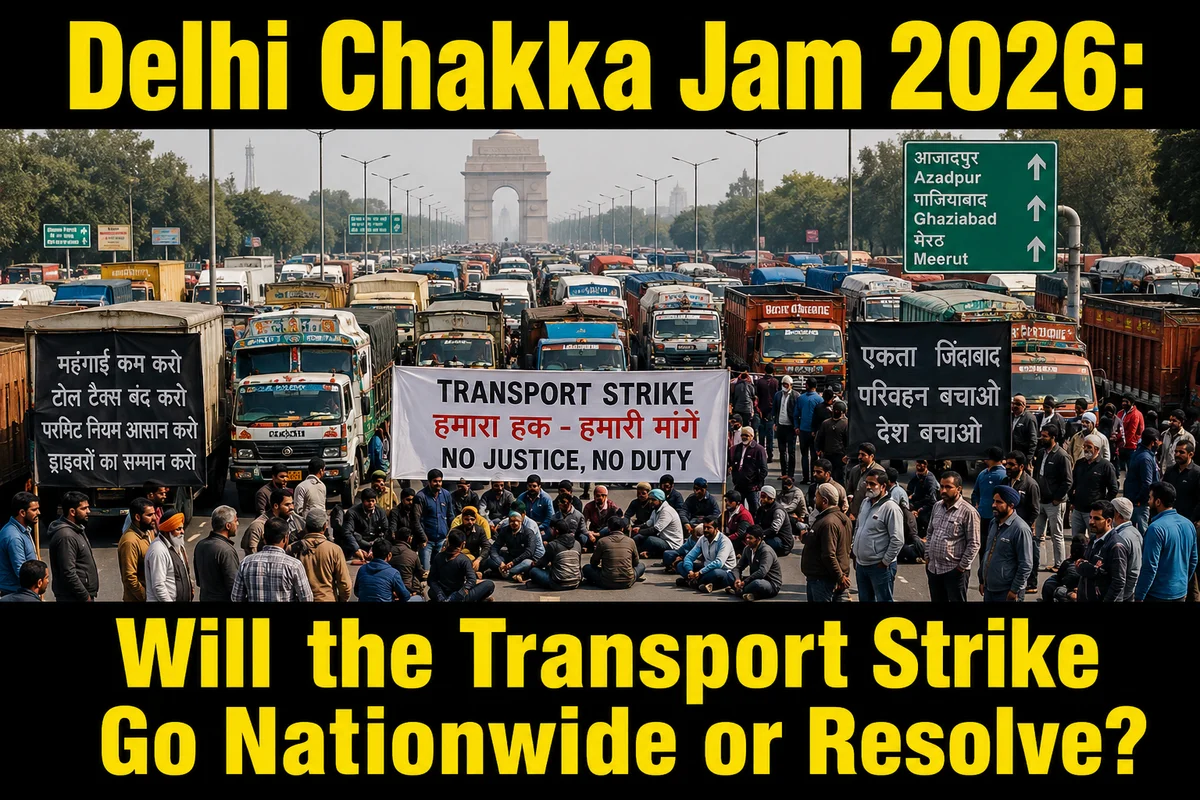
To look at this strike is to look at a mirror of Delhi itself—split sharply between the desperation of those who drive to survive and the fury of those who rely on them to move.
The Spark: The Boiling Point Under the Hood
This strike did not happen overnight; it is the explosion of a long-simmering economic pressure cooker. At the heart of the protest are the drivers of Delhi’s black-and-yellow autos, app-based cabs (Ola and Uber), and heavy commercial trucks. Their grievances are grounded in stark financial survival:
- The CNG Squeeze: While fuel prices and inflation have soared over the last few years, local transit fares have remained stubbornly stagnant. Drivers argue that after platform commissions and skyrocketing fuel costs, they are taking home pennies.
- The Environmental Tax Burden: Fleet operators are reeling under heavy hikes to the Environment Compensation Charge (ECC) imposed on commercial vehicles entering Delhi.
- The Vehicle Ban Threat: Impending, strict bans on older BS-IV commercial vehicles threaten to strip small-scale operators of their livelihood overnight, without viable financial pathways to upgrade to electric or BS-VI vehicles.
For the drivers, the Chakka Jam is not an inconvenience—it is a last-resort scream for dignity.
The Human Toll: Empathy vs. Anger
The Frustration of the Commuter
On the streets of Noida, Gurugram, and Delhi, the mood is chaotic. For the average commuter, empathy vanishes quickly when you are staring at a smartphone screen showing a 300% surge price on a ride that will ultimately be cancelled anyway.
From corporate employees missing critical meetings in Cyber City to parents struggling to find safe transport for their school children, the immediate reaction is anger. The city’s economy depends on mobility, and when that mobility is hijacked, everyday citizens bear the brunt of the collateral damage.
The Anxiety of the Supply Chain
Beyond the daily commute lies the quiet panic of the markets. Delhi’s massive wholesale hubs—like Azadpur Mandi—rely on a relentless nightly influx of thousands of trucks. With borders like Delhi-Gurgaon monitored and restricted, only a fraction of normal commercial traffic is trickling through. Wholesale traders are warning of imminent shortages, and the common citizen will likely see the outcome of this strike on their kitchen tables next week through spiked prices for fresh vegetables, fruits, and daily groceries.
The Silent Panic of the Airport Run
Perhaps the most stressful fallout is felt at Indira Gandhi International Airport. Missing a cab to work is annoying; missing an international flight because an entire sector’s cabs are off the road is catastrophic. Travelers have been forced to drag luggage over metro stairs and crowd into packed trains, navigating a stressful logistical nightmare just to leave the city.
The Oasis: Why the City Hasn’t Completely Collapsed
If there is a saving grace to this chaos, it is the Delhi Metro Rail Corporation (DMRC). Operating at full capacity, the metro has become the literal spine keeping Delhi upright. Platforms are overwhelmingly crowded, and coaches are packed to the brim, but the trains are moving.
Alongside the metro, public DTC buses and emergency vehicles have been exempted from the strike, ensuring that medical crises do not turn into tragedies.
The Uncertain Outcomes: What Happens Next?
As the strike enters its final stretch, the long-term outcomes remain highly uncertain, pointing toward three potential paths:
- A Hardline Standoff: If the government and transport departments refuse to negotiate on the ECC taxes and vehicle bans, the unions may threaten to extend the strike or launch periodic flash protests, plunging Delhi’s transit into long-term volatility.
- The Compromise (Fare Revisions): The most likely short-term resolution is a promised review of auto and taxi fare structures. While this would appease drivers, the ultimate outcome will be passed down to the consumer, making daily travel in Delhi permanently more expensive.
- The Acceleration of EV Transit: This friction will likely push both the government and ride-hailing giants to aggressively accelerate the transition to Electric Vehicles (EVs), bypass traditional commercial fleets, and permanently alter the landscape of gig-work driving in India.
The Possibility of Nationwide Expansion (Why it could catch fire) - The 2026 strike is uniquely dangerous because its driving factors are not isolated to Delhi. There is a very real possibility it could spill over into a countrywide crisis due to three main factors: [1]
- The Blueprint of the AIMTC: The protest is orchestrated by the All India Motor Transport Congress (AIMTC), a mammoth apex body that commands a network of 95 lakh truckers and 26 lakh passenger vehicle operators nationwide. If local negotiations fail, the AIMTC holds the organizational machinery to activate identical shutdowns across other major interstate economic corridors.
- Universal Financial Strain: Commercial drivers across India are facing identical financial suffocations—namely, stagnant base fares colliding with nationwide fuel price hikes, soaring vehicle insurance premiums, and pricey mandatory fitness certificates. The sentiment of “driving to lose money” is highly contagious among gig workers and fleet operators globally.
- The Aggressive Green Push: Transporters nationwide are watching how Delhi handles the upcoming restrictions on older BS-IV commercial vehicles and steep Environmental Compensation Charges (ECC). If other tier-1 metros like Mumbai, Bengaluru, or Kolkata attempt to mimic Delhi’s aggressive environmental policies without vehicle upgrade subsidies, localized flash strikes will inevitably ignite elsewhere.
The Urgent Need and Pathway to Resolution (How to stop the fire) - Because the transport sector is the literal backbone of the national economy, leaving it unresolved threatens to cause widespread supply-chain collapse, factory production pauses, and sudden inflation spikes in food and fuel. A resolution requires swift, structural compromise between the unions and authorities:
- Immediate Conditional Dialogue: As stated by AIMTC leadership, the primary requirement to halt escalation is an immediate sit-down meeting with top policymakers. Resolving this crisis requires the government to establish open channels to address grievances transparently, rather than relying on a hardline administrative standoff.
- The ECC and Transition Compromise: The most immediate policy fix involves modifying the collection of green taxes. A resolution could involve enforcing the ECC solely on transit vehicles passing through Delhi rather than vehicles bringing essential groceries and retail into the city, alongside providing longer grandfathering windows for existing BS-IV vehicles to protect small-time owners from sudden bankruptcy.
- Regulating App-Based Aggregators: To pacify the passenger transport unions (Ola, Uber, local autos), the state transport departments must step in to mandate updated base fare cards that mirror current CNG and fuel prices. Furthermore, introducing dynamic regulatory caps on the commission margins that ride-hailing platforms can extract from drivers would instantly resolve a core pillar of the strike.
- The Bottom Line: The Delhi Chakka Jam acts as a localized pressure valve for a massive national issue. If the government responds with rapid policy adjustments and structural dialogue, the strike will resolve quietly inside the NCR. However, if ignored, the underlying economic frustration could easily turn this local bottleneck into a nationwide logistics freeze
Ultimately, the 2026 Chakka Jam is a stark reminder that Delhi’s glittering, tech-driven infrastructure is built on the backs of underpaid human labor. When those wheels stop turning, the illusion of a seamless smart-city vanishes, leaving behind a stark reminder of the fragile balance between policy, progress, and human survival.



Comments (0)
Sign in to leave a comment