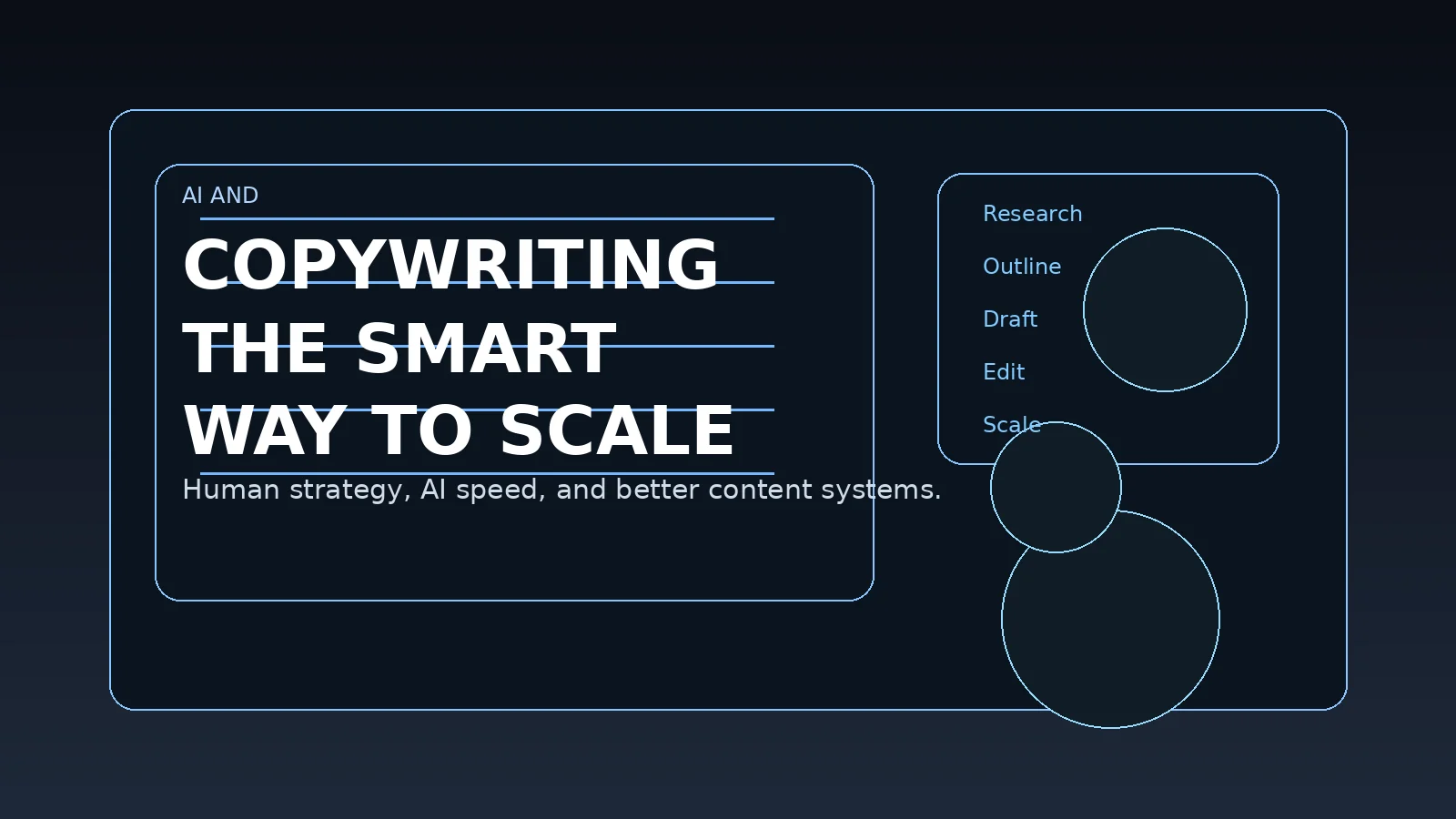
AI and Copywriting: The Smart Way to Scale
Copywriting is a craft. AI can speed it up, but it does not replace the core skill: clarity.
The real difference between good AI-assisted copy and weak AI-generated copy is not the tool. It is the system behind the tool.
Writers who use AI well do not ask it to replace taste. They use it to accelerate research, idea generation, drafting, and iteration.
Why AI Is Useful in Copywriting
Copywriting usually involves a mix of tasks that are repetitive, time-consuming, and mentally draining:
- brainstorming angles
- testing headlines
- summarizing product value
- rewriting for clarity
- adapting the same idea across formats
AI helps with those tasks well, especially when the writer gives clear direction and constraints.
That is where the leverage is.
The Risk of AI Copywriting
Most weak AI copy fails because it is generic.
It sounds polished, but it does not have a strong point of view. It lacks tension, clarity, rhythm, and strategic intent.
That happens when writers ask AI to generate finished copy without enough context, examples, or differentiation.
AI is not a substitute for positioning. It is a tool that can support positioning.
The Best Workflow for AI-Assisted Copywriting
Strong copy teams use AI in a structured way:
- define the audience
- define the core promise
- identify the objections
- create the angle
- draft the first version
- edit for tone and precision
That creates better output than asking a model to do “all the writing” in one step.
How AI Helps With Research
AI can quickly surface patterns in audience language, competitor messaging, and common objections.
This is useful because copy is not just about writing. It is about understanding the customer’s mental model.
The writer still needs to decide what matters and what should be emphasized. AI speeds up the discovery stage, not the strategic decision.
How AI Helps With Iteration
AI is especially useful when you need multiple versions of the same message.
For example, the writer may want:
- three headline options
- two versions for different audiences
- a short social version
- a punchier CTA
- an FAQ-based landing page variation
This is a perfect fit for AI because it expands options quickly without replacing the writer’s editorial judgment.
Where Human Writers Still Win
Human writers win at:
- strategic framing
- voice and taste
- tone calibration
- emotional precision
- persuasive structure
AI can help generate possibilities. Humans decide what is worth keeping.
Best Practice for AI Copywriting
Use AI with clear brief structure. Give it:
- audience
- offer
- tone
- goal
- proof points
- premium or conversion angle
Then review the result with a sharp eye.
That is the difference between output that feels mechanical and copy that actually converts.
Final Thought
AI does not make writers less important. It makes clear, strategic writers more powerful.
The strongest copy workflows combine human judgment with machine speed.
That is how content scales without losing quality.
Comments (0)
Sign in to leave a comment