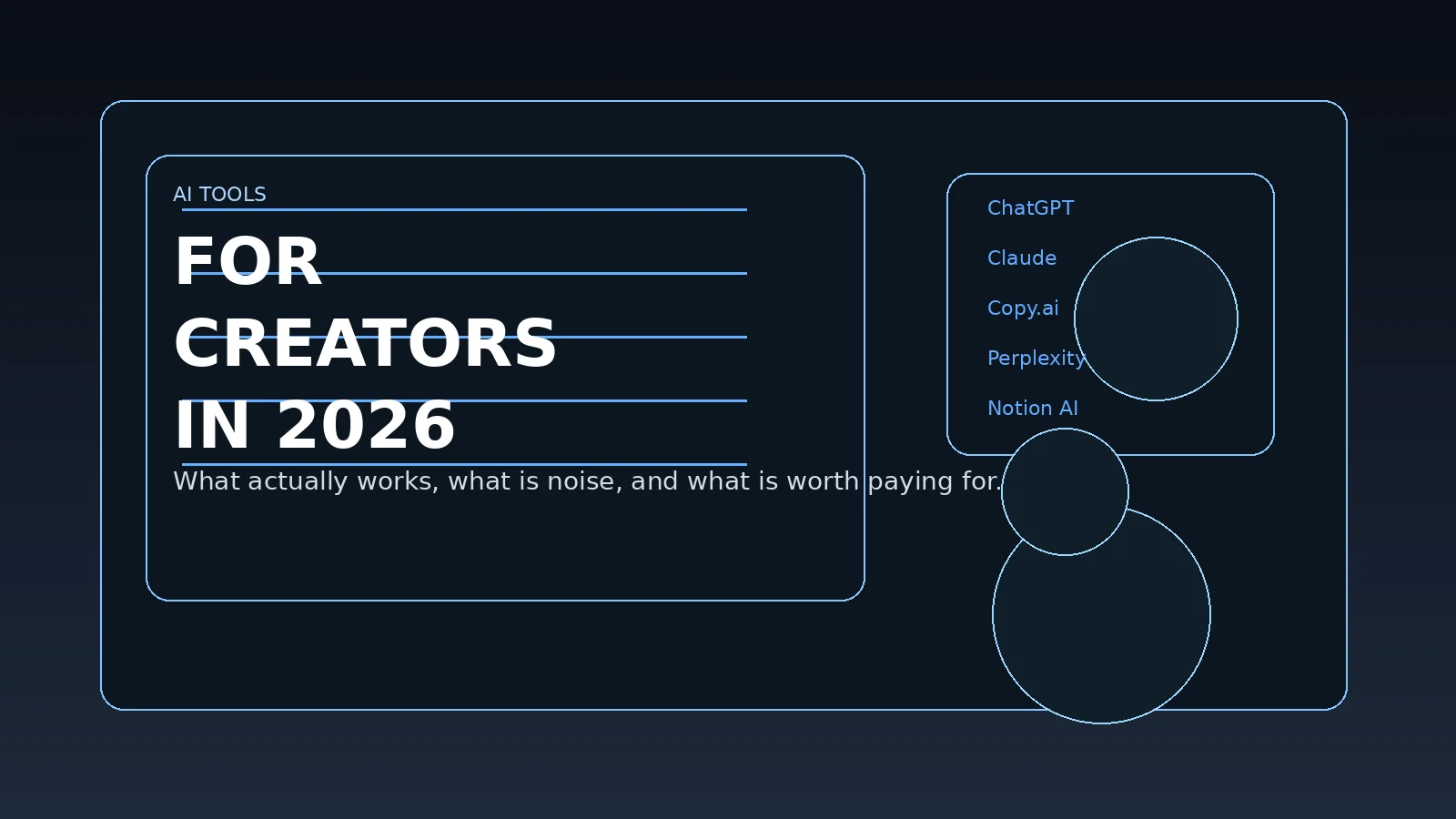
AI Tools for Creators in 2026: What Actually Works
The AI market is crowded. Every tool promises to make content easier, faster, and smarter.
For creators, the challenge is not finding more tools. It is choosing the ones that actually help with the real work: research, drafting, editing, repurposing, and organizing ideas.
In 2026, the best AI tools are not the loudest. They are the tools that fit directly into a real creator workflow.
What Creators Really Need from AI
Most creators do not need a tool that does everything. They need a tool that removes friction from the work they already do.
The best AI tools help with:
- turning rough notes into structured ideas
- drafting a first version of an article or newsletter
- summarizing long source material
- rewriting for clarity, tone, and audience
- repurposing one long piece into several short assets
- staying organized across research, writing, and publishing
When a tool supports those tasks well, it becomes useful. When it adds noise and complexity, it becomes a distraction.
Best Tools for Research
Research is one of the most valuable use cases for AI tools. A creator often has a topic, a deadline, and a pile of information. The real challenge is filtering signal from noise.
Tools like Perplexity and ChatGPT are useful when they are used to gather and summarize multiple sources. They reduce time spent searching across dozens of pages.
But they work best when the creator provides a clear angle and the right constraints. Otherwise, the results are broad and shallow.
Strong research workflows look like this:
- define the objective
- tell the tool the audience
- ask for a summary of the main arguments
- compare perspectives
- review and fact-check the final output
Best Tools for Writing
Writing tools are now part of the normal creator stack. But not all of them are equally useful.
Some tools are strongest at first drafts. Others are better at editing. Some are better at structure. Others are better at rewriting tone and flow.
For creators, the best workflow is usually this:
- use AI for a rough draft
- review for clarity and originality
- tighten the message and examples
- refine the tone to match the brand
The key is not to let the tool write the entire voice of the brand. That creates bland or generic content. The better use is to support the writer, not replace them.
Best Tools for Content Repurposing
One of the highest-value tasks for creators is repurposing. A single article can become a newsletter, a LinkedIn post, a short video script, a summary carousel, or a thread.
This is where AI becomes extremely useful.
Instead of rebuilding each format from scratch, the creator can take the core idea and ask the tool to:
- turn it into a shorter version
- rewrite for a different channel
- create multiple title variations
- generate social snippets
- build a second draft for a different audience
That saves real time without reducing the strength of the underlying idea.
The Tool Trap
Many creators get trapped by the tool trap.
They pile on new apps because they feel they need more AI capability. But the best creator stacks are usually small, deliberate, and deeply integrated into the workflow.
Common mistakes include:
- using too many tools at once
- switching between platforms without a process
- letting AI change the voice of the brand
- skipping the edit and review step
- assuming every new tool is automatically useful
In practice, fewer, better tools usually outperform a bloated stack.
Which AI Tools Are Worth It?
There is no single best tool for every creator. Value depends on the type of work you do.
- Writers benefit most from strong drafting and editing support.
- Video creators benefit from summarizing, scripting, and repurposing workflows.
- Newsletter operators benefit from research, long-form summarization, and short-form adaptation.
- Founders benefit from quick research, idea generation, and product messaging support.
The best creators use AI as a workflow multiplier, not as a replacement for taste.
What to Ignore
Not every AI feature is worth attention.
Ignore tools that:
- promise magic outcomes with no process
- create generic content
- add extra tools without a clear workflow
- replace core judgment instead of supporting it
Good AI tools help you execute better. Weak AI tools create noise.
Final Thought
In 2026, the AI edge for creators is not about collecting the most tools. It is about building the right workflow around a small set of tools that actually improve output.
The real value is not in using AI for everything. It is in using it for the parts of the work that are repetitive, slow, or mentally heavy.
That is where creators gain leverage.
Comments (0)
Sign in to leave a comment